Insight piece · 14 September 2026 · 6 min read
Before You Delete the Role, Do You Understand What You Are Deleting?
There is growing pressure to flatten organisations, widen spans of control and release capacity through technology and AI. But before deleting a role, do we genuinely understand what that person does and the gap they will leave?
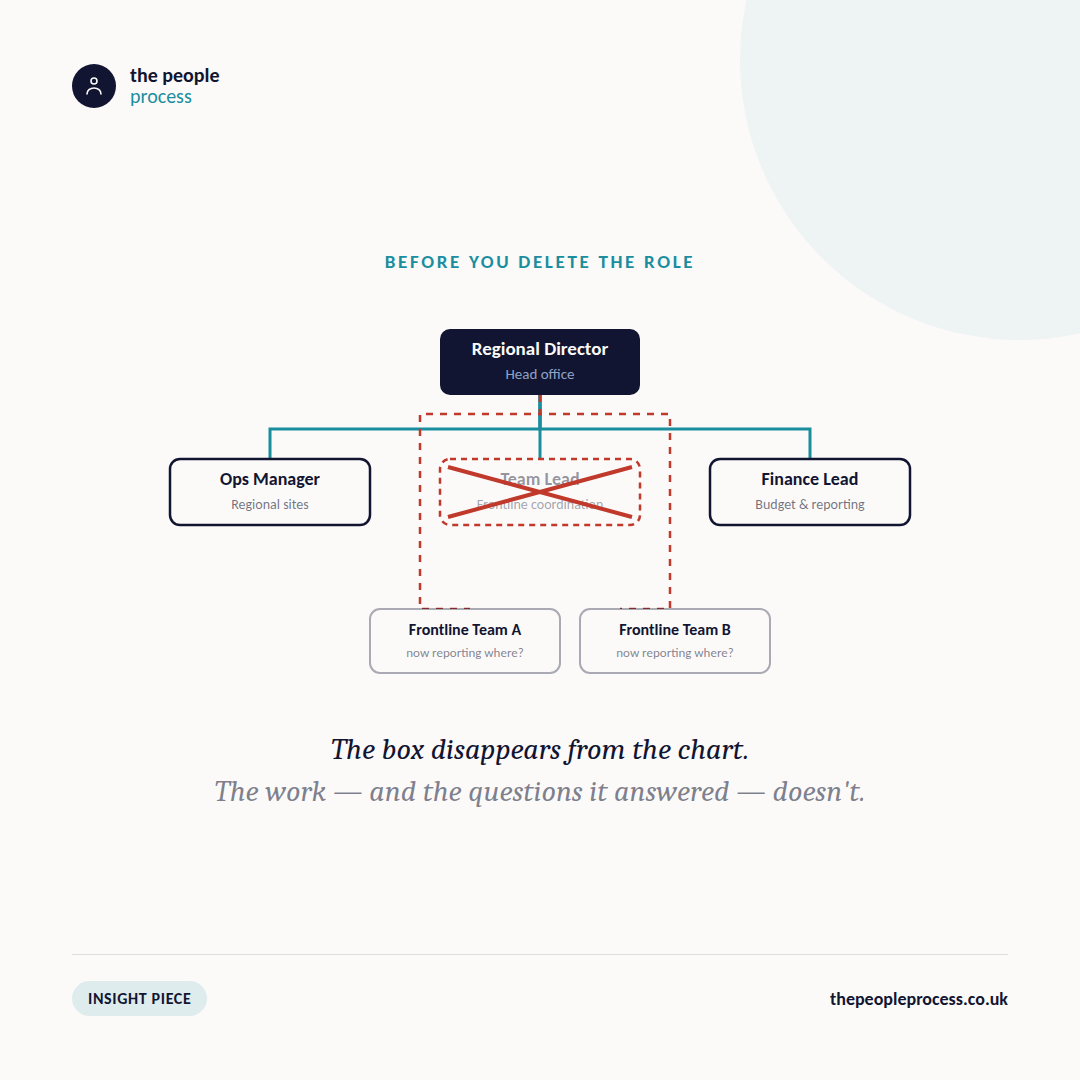
There is growing pressure to flatten organisations, widen spans of control and release capacity through technology and AI.
That may be entirely right. Organisations should remove unnecessary hierarchy, duplication and work that no longer adds value.
But before deleting a role, there is a more important question:
Do we genuinely understand what that person does and the gap they will leave?
Knowing someone's title, salary and position in the structure is not the same as understanding their contribution.
Job descriptions rarely capture the informal work that keeps an organisation functioning: resolving exceptions, joining disconnected processes, checking unreliable data, maintaining relationships, coaching colleagues and remembering why particular decisions or controls exist.
Much of this work remains invisible until the person performing it is no longer there.
Removing the role does not remove the work
When a role disappears, its work must stop, be automated or move somewhere else.
The danger is that organisations remove the position without making a conscious decision about which of those outcomes applies.
The salary saving appears in the business case, but the transferred workload does not. Employees compensate through longer hours and workarounds. Managers inherit more decisions and larger teams. Service slows, controls weaken and contractors are eventually introduced to fill the gaps.
The cost has not disappeared. It has moved somewhere less visible.
That concern is particularly relevant following reports that Meta is asking some former managers to return to management roles, partially reversing its move towards smaller, manager-light teams.
It raises an interesting question: did the organisation remove unnecessary hierarchy or discover that those managers had been carrying work the organisation had never properly identified?
Is the role unnecessary or compensating for poor design?
Some roles should undoubtedly be removed. But first we need to understand why they exist.
Is an administrator performing unnecessary activity, or manually connecting systems that do not integrate?
Is a regional role duplicating a global function, or translating it into local legislation, culture and operational reality?
Is a manager supervising too few people, or coordinating complex work across teams with unclear decision rights?
Trent Cotton's Ownership Threshold Test makes a similar point: removing a management layer only accelerates decisions when authority and judgement have already moved to the people doing the work. Otherwise, the box disappears but the decisions simply move upwards.
This also connects with Mervyn Dinnen's question: Are Your Managers Ready for the Transformation You're Asking Them to Lead?. Managers are frequently expected to absorb the practical and emotional consequences of change without the capacity, preparation or authority to do so.
Technology makes this more important
As I argued in Are We About to Repeat the Same Mistakes With AI?, automating an activity is not the same as redesigning the end-to-end process.
A system may produce the report, answer the standard question or process the transaction. But who recognises when the information is wrong? Who deals with the exception? Who understands the consequence for Payroll, Finance, the customer or the employee?
Automating the visible task does not necessarily replace the complete contribution of the person performing it.
This does not mean preserving roles simply because they have always existed. It means designing the future work deliberately rather than assuming the remaining organisation will absorb whatever the technology or the restructuring leaves behind.
Map the work before changing the structure
Before removing a position, organisations should be able to answer:
- What does this person really do, including informal decisions, relationships and workarounds?
- Why does that work exist?
- What can genuinely stop?
- What will be automated?
- Where will the remaining work go and will the necessary capacity and authority move with it?
- How will we measure the impact beyond the immediate headcount saving?
A flatter organisation is only simpler when unnecessary work has been removed, processes redesigned and decision-making moved closer to where the work happens.
Otherwise, the hierarchy disappears from the organisation chart while continuing through escalations, informal relationships and overloaded employees.
We may understand what the person costs. But before deleting the role, we need to understand what they contribute and what will happen when they are gone.
Related insight
About the author
Juli Oliver-Smith is a transformation and people change consultant – senior interim, consultancy and programme leadership across people, process, technology and transformation.
More about JuliFound this useful? Get my monthly newsletter, Understand the Work First, on LinkedIn – or start a conversation.